Future Telescopes & Instruments
Research articles on future telescopes, spectrographs, and instruments for exoplanet science.
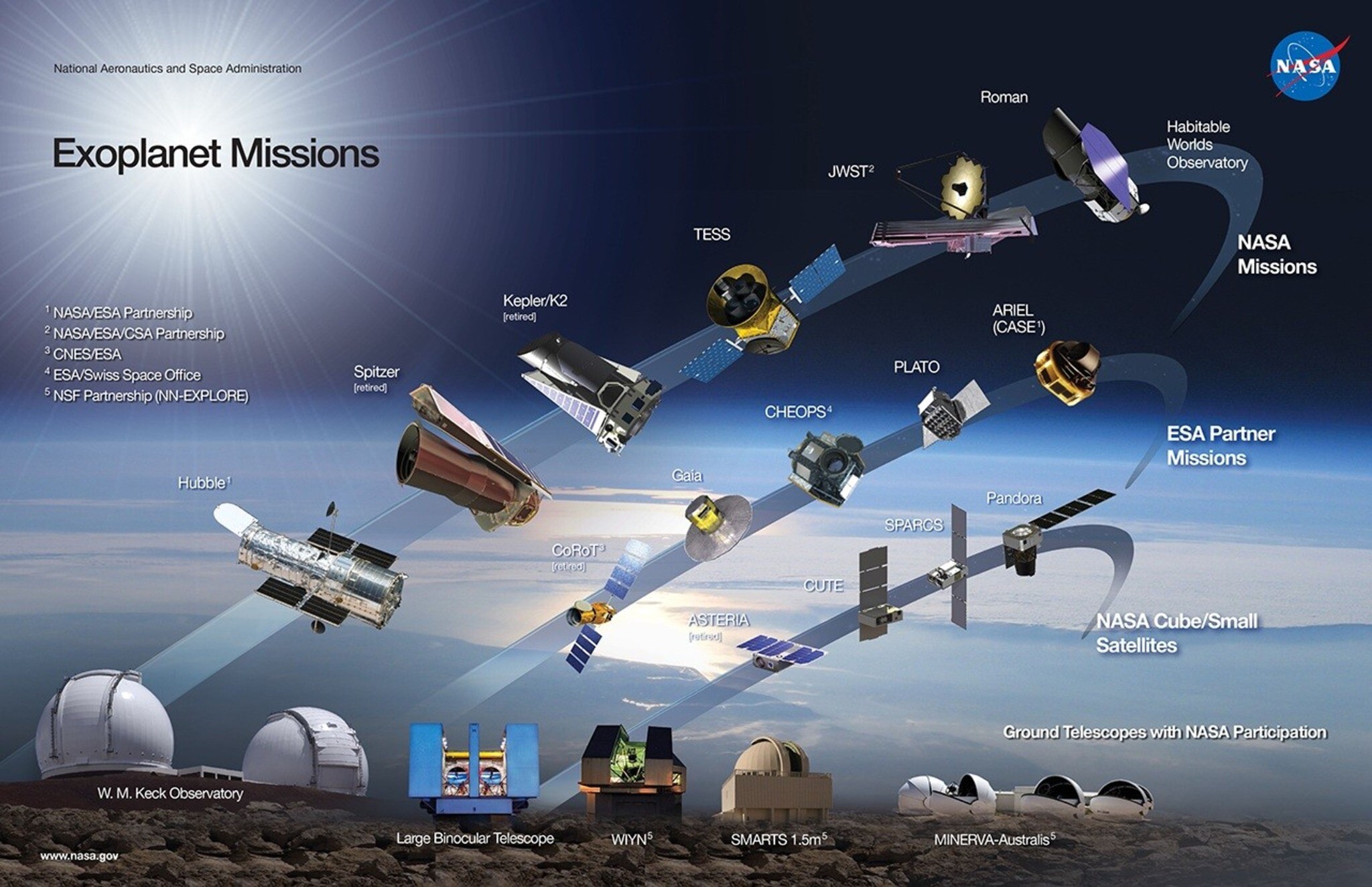
Future facilities will move atmospheric characterization toward smaller and cooler worlds while measuring much larger and more diverse samples. My work examines the observing strategies and instrument capabilities needed to turn faint planetary signals into robust atmospheric measurements, from Ariel's population survey to the direct-imaging era of the Habitable Worlds Observatory.
Research highlights
Beyond Five Scale Heights: Ariel Tier-2 requirements for sub-Neptunes
The Ariel Mission Candidate Sample uses a clear hydrogen-helium atmosphere and a five-scale-height signal as a common screening reference. We tested how the Tier-2 observing requirements change for 197 known sub-Neptunes when metallicity and clouds are included explicitly. Synthetic spectra at 1×, 10×, and 100× solar metallicity - with clear atmospheres and 1-mbar cloud decks - were evaluated in Ariel AIRS channels using target-specific noise estimates.
Clear solar-composition atmospheres largely follow the mission reference, but high mean molecular weight and clouds can substantially increase the observing time. The 1×-solar cloudy case requires nearly an order of magnitude more transits than the simple prediction, and most tested scenarios require more visits for a robust spectral detection. The study also identifies Ariel targets with detected metastable helium, connecting lower-atmosphere composition and clouds to extended escaping upper atmospheres.
Preparing for the Habitable Worlds Observatory
Work is also underway for the Habitable Worlds Observatory (HWO). I am exploring how atmospheric evolution, escape, reflected-light spectroscopy, and the interpretation of biosignatures and technosignatures can inform target selection and observing strategies for nearby potentially habitable worlds.