Escaping Atmospheres
Research articles on atmospheric escape, metastable helium, thermospheres, and extended planetary tails.
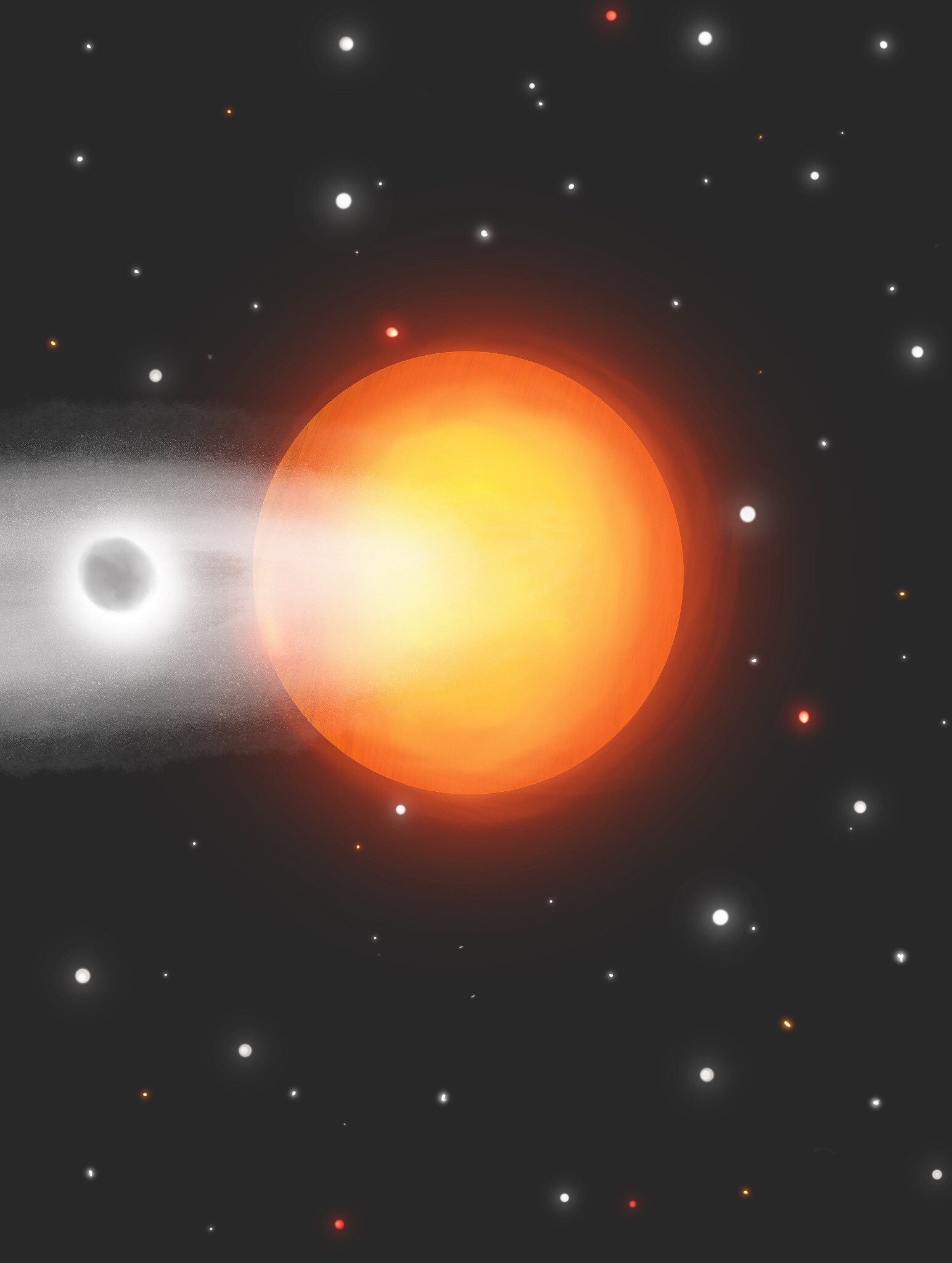
Metastable helium at 1083 nm is a powerful tracer of gas escaping from irradiated planets. My work uses high- and low-resolution transmission spectroscopy and time-resolved observations to measure thermospheres, outflows, and extended leading and trailing tails. Taken together, detections and carefully measured non-detections reveal which planets retain primordial envelopes, how irradiation shapes escaping gas, and how atmospheric loss helps sculpt the observed planet population.
Research highlights
Continuous helium absorption from both tails of WASP-107 b
Using a continuous JWST/NIRISS observation, we detected helium absorption beginning well before the optical transit and persisting after it. The signal traces both a leading structure and a much longer trailing tail, revealing an escaping thermosphere extending tens of planetary radii. Three-dimensional EvE simulations reproduce the asymmetric helium light curve and show how the stellar wind, radiation pressure, and orbital motion shape the outflow.
This result turns the transit into a time-resolved map of atmospheric escape: instead of measuring only the gas directly in front of the planet, we follow material distributed along its orbit.
Escaping helium around WASP-121 b
In this Nature Communications study led by Romain Allart, a continuous JWST/NIRISS phase curve revealed helium absorption over nearly 60% of the orbit. The gas separates into leading and trailing structures that span more than half the orbit, demonstrating that escape from highly irradiated planets can form complex, planet-scale and orbit-scale morphologies.
NIRPS and the delayed helium escape of WASP-69 b
As part of the NIRPS collaboration, I contributed to a three-transit study that recovered a 3.17% helium signal and a delayed post-transit tail. EvE simulations connect the time-variable line profile to the three-dimensional outflow, while the Rossiter-McLaughlin measurement places the escape in the context of the planet's mildly misaligned orbit. This work builds on the instrument's on-sky performance and science programme and early-science results.
Where is helium most readily detected?
Krishnamurthy & Cowan re-analysed 17 detections and 40 non-detections to identify the stellar and orbital conditions that favour metastable-helium absorption. The sample reveals an orbital "sweet spot" at roughly 0.03-0.08 au, dependencies on the stellar XUV-to-MUV radiation balance, and population-level trends that help distinguish physical absence from observational selection.
No extended helium around three radius-gap planets
Subaru/IRD transit spectra of GJ 9827 b, GJ 9827 d, and TOI-1235 b yielded stringent helium upper limits. Coupled with wind calculations and the planets' bulk properties, these non-detections are more consistent with photoevaporation and/or core-powered mass loss than with gas-poor formation alone. Non-detections are therefore physical constraints, not empty results: they test whether a low-density envelope is still present and escaping.
Helium non-detections for TRAPPIST-1 b, e, and f
High-resolution IRD and HPF observations found no evidence for extended, primordial hydrogen-helium atmospheres around these three terrestrial planets. The upper limits narrow the permitted mass-loss regimes and shift attention toward higher-mean-molecular-weight atmospheres - an important step in understanding what kinds of atmospheres the TRAPPIST-1 planets may retain.