Astrobiology
Research articles on planetary habitability, atmospheric evolution, and astrobiology.
Astrobiology connects planetary environments, the energetics of life, and the search for biological and technological signatures. My work asks how physically measurable quantities can place life and technology in a common comparative framework, from Solar System worlds to exoplanets that future observatories may characterize.
Research highlights
Energetic Decoupling from Biological Scaling: A Dimensionless Framework for Technological Civilizations
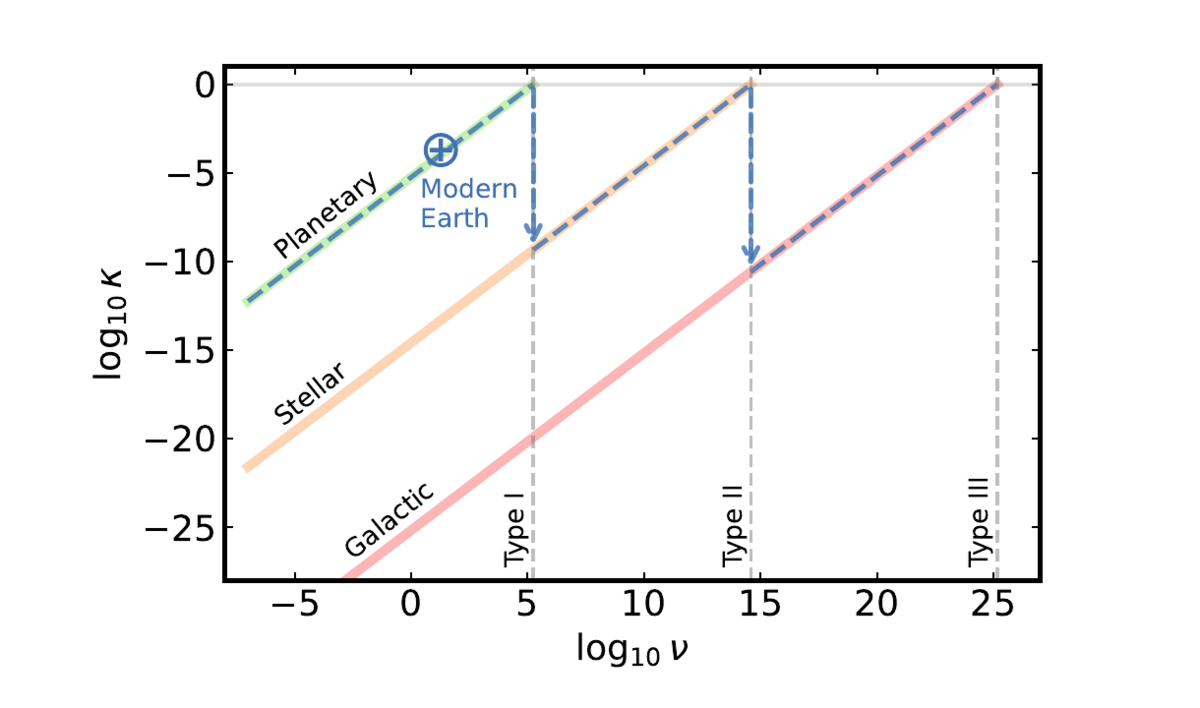
This novel study extends species-level biological scaling by treating externally harvested technological energy as a separate part of a civilization's power budget. It introduces two dimensionless coordinates: the biological decoupling parameter, ν = Pext/Pbio, and the environmental utilization parameter, κ = Pext/Pavailable. The first measures how far technological power has moved beyond collective metabolism; the second measures how much of an explicitly defined environmental energy resource is being used.
Together, ν and κ define a continuous phase space connecting biological organisms, present-day technological societies, and Kardashev-type civilizations without relying only on absolute power consumption. In the adopted planetary-energy normalization, modern humanity has ν ≈ 24 but κ ≈ 1.1 × 10⁻⁴: technological power already exceeds collective metabolism, while only a small fraction of the accessible planetary energy resource is used.
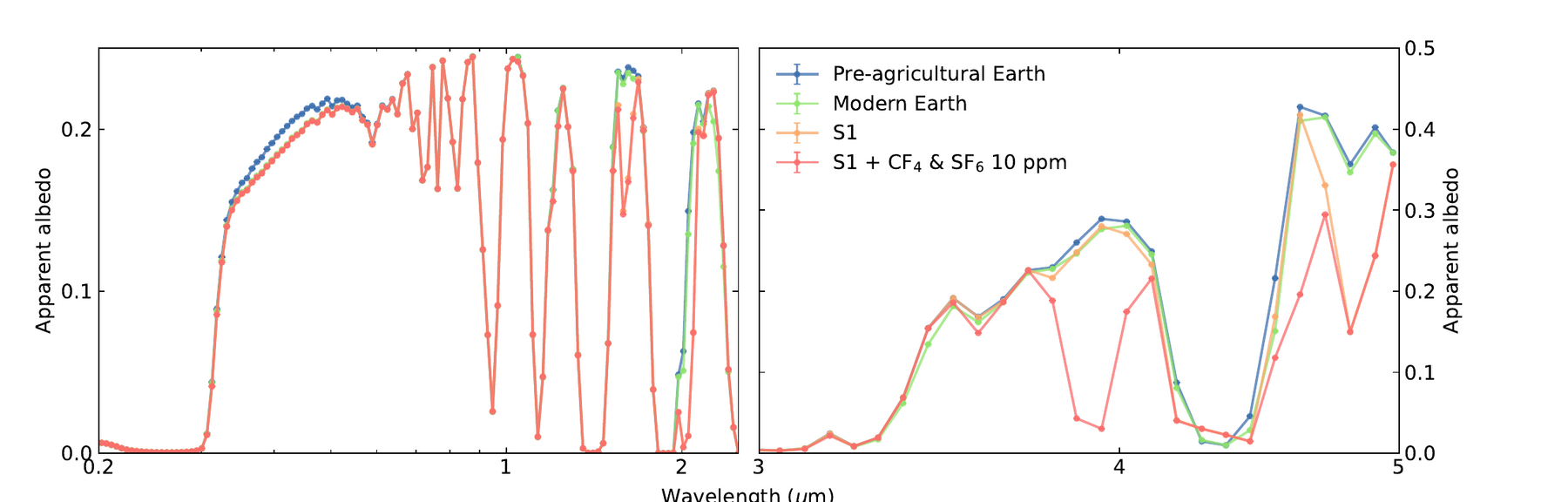
The framework also provides a common language for interpreting technosignatures. Reflected-light spectra illustrate how industrial gases such as CF4 and SF6 could alter an Earth-like planet's spectrum, connecting future atmospheric measurements to model-dependent bounds on a civilization's energetic state.
The title link points to an arXiv title search and can be replaced with the final abstract URL once posted.